Best SAP BASIS Training Institute With Placements In Coimbatore
SAP BASIS Course in Coimbatore: Run, Secure and Upgrade SAP Systems
When an SAP system slows down at month-end, a user gets locked out, or a company moves from ECC to S/4HANA, the BASIS team takes the call. SAP BASIS administrators keep SAP running: installing it, monitoring it, moving changes safely, managing users and backups, and upgrading it. Our SAP BASIS course in Coimbatore teaches all of that on a live system, plus the newer skills companies now expect: SAP HANA database admin, S/4HANA conversion and running SAP in the cloud. It's a good fit if you like systems more than business processes. Join a classroom batch at our Ram Nagar institute or a live online batch.
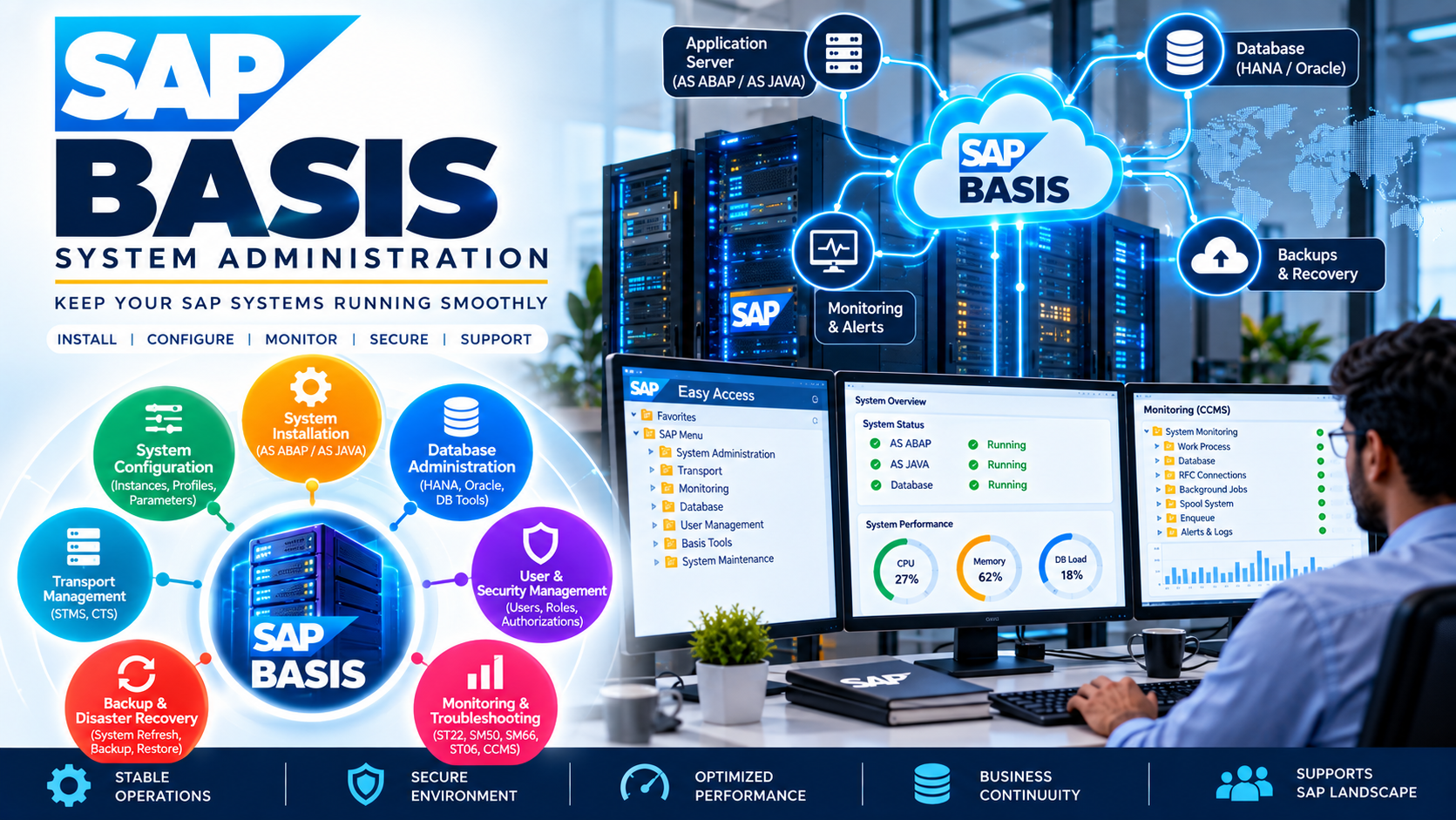
Our SAP BASIS training focuses on the technical administration of SAP environments. You will learn how to install and configure SAP systems, monitor system performance, manage users and authorizations, handle transports, perform backups and troubleshoot common system issues.
The course also covers modern SAP administration requirements such as SAP HANA database administration, S/4HANA system conversion and SAP cloud environments. By working on a live system and practical administration scenarios, you can build the skills required for SAP BASIS administrator, SAP system administrator and SAP technical support roles.
Benefits of Learning SAP BASIS Course
-
Learn SAP BASIS administration from the fundamentals through practical system installation, configuration, monitoring and troubleshooting. Build a strong foundation for a career in SAP technical administration and support.
-
Understand essential SAP system administration activities such as user management, authorizations, backups, transports and system monitoring. Work with scenarios that SAP administrators handle in real environments.
-
Get practical exposure to SAP HANA database administration, S/4HANA conversion and modern SAP cloud environments. Learn how technical administration changes as companies move to newer SAP platforms.
-
Develop troubleshooting and performance-monitoring skills for common SAP system issues, including slow systems, user access problems and safe movement of changes between environments.
-
Build hands-on skills through live-system administration exercises and practical scenarios. The training is suitable for candidates interested in SAP BASIS, system administration, technical support and SAP infrastructure roles.
SAP BASIS Course Syllabus
The SAP BASIS syllabus starts with how SAP is built, then moves through daily administration, the HANA database, and finally upgrades, conversions and cloud.
-
SAP system architecture: application server, database, presentation layer
-
Instances, work processes, dispatcher, message server
-
Three-system landscape: development, quality, production
-
Clients and client strategy
-
Installing an SAP system with Software Provisioning Manager (SWPM)
-
Post-installation steps, licence and profile parameters
-
Operating system basics for BASIS (Linux commands you'll actually use)
-
Work process, system log, dump and background job monitoring
-
Spool and printer administration
-
Lock entries and update requests
-
Logon groups and load balancing
-
User administration and mass user changes
-
Roles and authorisations with PFCG
-
Password and security parameters
-
Introduction to SAP Security and GRC (the next step many BASIS admins take)
-
Transport Management System (STMS) and transport routes
-
Client copy, client export/import
-
System refresh (copying production to quality)
-
HANA architecture and HANA Cockpit
-
Backup, recovery and log management
-
Monitoring memory, CPU and disk
-
Users and security in HANA
-
Kernel updates, support packages (SPAM) and add-ons (SAINT)
-
Software Update Manager (SUM) and Database Migration Option (DMO)
-
The technical steps of an ECC to S/4HANA conversion
-
Running SAP on AWS, Azure and GCP
-
RISE with SAP: what changes for BASIS teams
-
SAP BTP basics for administrators
-
Workload analysis, buffers, SQL trace
-
RFC connections and interface troubleshooting
-
Handling real incidents step by step
-
End-to-end projects (below), mock certification tests, resume and mock interviews
Why Choose Us?
Why choose Refinement Software Solutions as your IT training Institute?

Study from remote locations
Our online course aims to improve coding abilities through group projects led by teachers and other participants.

Reason based learning
Gain comprehensive of a subject by understanding its WHAT, WHY, and HOW aspects, simplifying the subject matter for in-depth comprehension.

Live & Interactive
Engage in discussions, ask questions, and seek clarifications from our certified instructors with extensive experience in the subject matter.

Mentored by industry experts
Experienced industry practitioners mentor with over ten years of experience. Provide timely reviews and feedback on assignments and projects.

Curriculum designed by experts
Our Course curriculum undergoes multiple levels of design and preparation by experts to ensure relevance to daily technological changes.

Blended learning model
Our learning methods offer the best classroom training and online learning. And our courses designed to meet individual needs and preferences.
FAQ
SAP BASIS Course FAQs
SAP BASIS is the technical layer that runs every SAP application, and the admin work that keeps it running: installation, monitoring, user management, transports, backups, performance and upgrades.
It's commonly expanded as "Business Application Software Integrated Solution", but that isn't an official SAP definition. SAP simply calls it Basis, and in practice it means SAP system administration.
Our SAP BASIS course fees in Coimbatore are [fees range], depending on classroom or online mode. That includes practice system access, projects, mock tests and placement support. The SAP exam fee is separate.
The course takes [course duration], about [total hours] hours including projects. The BASIS + Linux + AWS path takes longer.
No programming is needed. You do need to be comfortable with operating systems, especially Linux, and basic database and networking ideas. We cover the Linux commands BASIS admins use.
ABAP developers write programs inside SAP. BASIS administrators keep the SAP system itself running: servers, database, users, transports and upgrades. ABAP is coding. BASIS is administration.
Yes. Every company running SAP needs BASIS support, and ECC to S/4HANA conversions and cloud moves keep demand steady. Admins with HANA and cloud skills are especially sought after.
Some do. Support roles often cover global customers, so rotating shifts are common in the first few years. Project and consulting roles usually have regular hours.
The official exam is booked and paid through SAP, currently [SAP exam fee]. It's not part of our course fee. We prepare you for it with mock tests.
Yes, that's a common path. BASIS covers user and role basics, and many admins specialise in SAP Security and GRC after a year or two.
Yes. Live online batches have the same trainer, system access and projects as the classroom batch at Ram Nagar.