Java Course in Coimbatore
Java Course in Coimbatore
Build practical programming skills with the Java course in Coimbatore offered by Refinement Software Solutions. The training path covers Java fundamentals, object-oriented programming, database connectivity, and full stack development concepts. Explore our Java Full Stack Developer Course in Coimbatore and contact our team to discuss your learning goals.
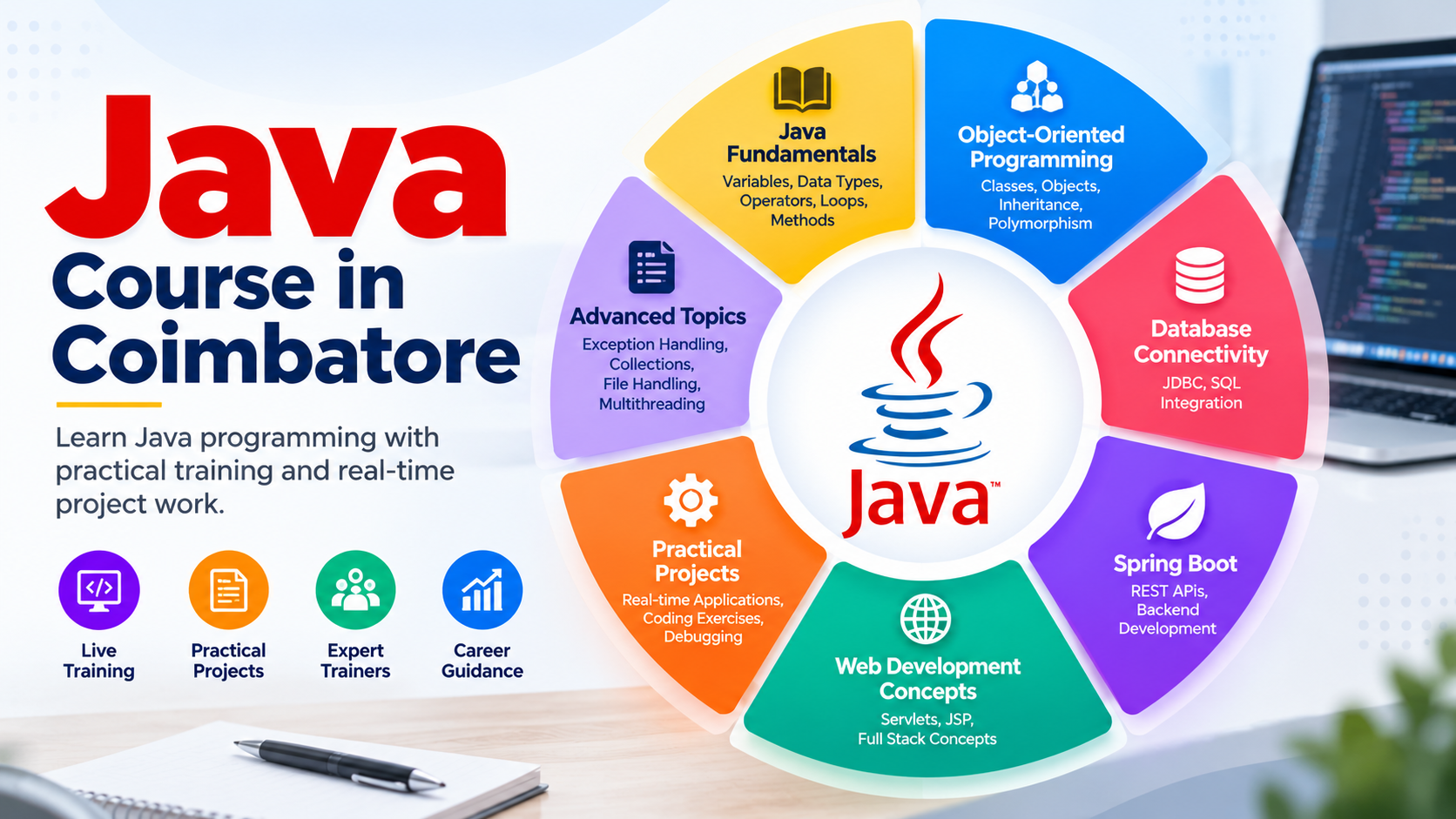
Java is a programming language used to build different types of software applications. Learning Java helps students understand how programs work, how data is processed, and how application logic is developed. These skills can support learners who want to enter software development or strengthen their existing programming knowledge.
The course is suitable for college students, fresh graduates, aspiring developers, and professionals who want structured Java training. The learning path should combine concepts, coding exercises, debugging, database work, and practical projects so students can apply what they learn.
Why Choose a Java Course in Coimbatore?
A Java course gives learners a structured way to develop programming skills, practise coding, and understand application development. The right training programme should balance clear explanations with regular coding exercises and feedback.
At Refinement Software Solutions, the existing Java Full Stack course covers programming fundamentals and advanced topics alongside front-end development concepts.
With Placements
Students should review the available curriculum and confirm the current batch details before enrolling.
Learn Java from the Fundamentals
Beginners need to understand variables, data types, operators, conditions, loops, methods, and arrays before moving into larger programmes. These concepts form the base for writing readable code and solving programming problems.
A structured learning process helps students practise each topic before progressing. For example, a learner can first write a simple calculator, then develop a menu-driven application that accepts input and processes data.
Understand Object-Oriented Programming
Java uses object-oriented programming concepts to organise code around classes and objects. Students learn inheritance, encapsulation, polymorphism, and abstraction as part of the progression from small programmes to larger applications.
Understanding these concepts makes it easier to read existing code, separate responsibilities, and build applications that are easier to maintain. OOP knowledge also forms part of the foundation for many Java interview questions.
Practise Application Development
Reading code is not enough to develop programming confidence. Learners need to write programmes, identify errors, test different inputs, and correct their logic.
Regular practice can include small applications, database-connected programmes, and a final project. The exact project list should be confirmed with the training team before enrolment.
Java Full Stack Course Syllabus
Learn Java programming fundamentals, object-oriented programming, database connectivity, frontend development, Servlets, JSP, Hibernate, Spring Framework, Spring Boot and REST API development.
-
History and introduction to Java
-
Java SE, Java EE/Jakarta EE and Java ME
-
JVM, JRE and JDK
-
JDK installation, PATH and JAVA_HOME configuration
-
Java programs and Eclipse IDE setup
-
Variables, static and non-static variables
-
Primitive and non-primitive data types
-
Operators and type casting
-
Conditional statements: if, else, nested if and switch
-
Loops: while, do-while, for and enhanced for
-
Break, continue, arrays and command-line arguments
-
Keyboard input and method argument passing
-
Classes, objects and constructors
-
Inheritance and extends keyword
-
Access modifiers: public, private, protected and default
-
super and final keywords
-
Multiple inheritance in Java
-
Method overloading and constructor overloading
-
Method overriding and polymorphism
-
Encapsulation and data hiding
-
Abstraction using abstract classes
-
Interfaces and object initialization
-
Exception handling fundamentals and hierarchy
-
try, catch, finally, throw and throws
-
User-defined exceptions
-
Collections Framework fundamentals
-
List, ArrayList and LinkedList
-
Set, HashSet and TreeSet
-
Map, HashMap and TreeMap
-
Vector, Stack, Enumeration, Dictionary and Properties
-
Generics and annotations
-
Thread class and Runnable interface
-
Thread model and lifecycle
-
start() and run() methods
-
Thread scheduling and concurrency
-
Deadlocks and synchronization
-
Synchronization using methods and blocks
-
Lambda expressions and method references
-
Static and default methods in interfaces
-
Filtering concepts
-
Java streams and stream types
-
Command-line arguments and BufferedReader
-
Scanner and DataInputStream
-
FileOutputStream and BufferedOutputStream
-
ByteArrayOutputStream and output streams
-
FileWriter and BufferedWriter
-
FileInputStream and BufferedInputStream
-
FileReader and SequenceInputStream
-
Reading and writing data
-
Creating folders, listing files and renaming files
-
File and folder deletion
-
Reading and writing Excel files
-
Frontend development overview
-
HTML structure, tags and elements
-
Semantic HTML, forms, tables and accessibility
-
CSS selectors, properties and box model
-
Flexbox, Grid and responsive web design
-
Sass/SCSS fundamentals
-
JavaScript variables, data types and functions
-
DOM manipulation and event handling
-
Conditions, loops, scope and functions
-
Arrow functions, template literals and destructuring
-
Callbacks, Promises and async/await
-
Introduction to React, Vue.js and Angular
-
Introduction to jQuery and D3.js
-
Bootstrap containers, grid, buttons and dropdown navigation
-
Servlet introduction and web terminology
-
Servlet lifecycle and working examples
-
HttpServletRequest and HttpServletResponse
-
Redirects, ServletConfig and ServletContext
-
Servlet attributes
-
Cookies and hidden form fields
-
URL rewriting and HttpSession
-
JSP introduction and lifecycle
-
JSP scripting elements and implicit objects
-
JSP page, include and taglib directives
-
JSP action elements and JavaBeans
-
Expression Language and MVC concepts
-
Installing MySQL and MySQL Workbench
-
Setting up a Hibernate project
-
Hibernate configuration
-
SessionFactory and Session
-
Creating entity classes
-
CRUD operations: create, read, update and delete
-
Hibernate Query Language (HQL)
-
Listing records using HQL
-
Filtering records with WHERE clauses
-
Updating and deleting records using HQL
-
Database connectivity and displaying records
-
Spring Framework setup and required software
-
Creating a Spring project
-
Inversion of Control (IoC)
-
Dependency Injection (DI)
-
Spring beans and autowiring
-
Constructor injection and Qualifier annotation
-
Spring MVC setup and project configuration
-
Model, View and Controller concepts
-
Request parameters and form handling
-
Radio buttons, dropdowns, text areas and checkboxes
-
Database connectivity with Spring MVC
-
DAO patterns and database operations
-
Maven fundamentals and project setup
-
Creating a Spring Boot application
-
Spring Boot web applications
-
Application properties and project packaging
-
Building RESTful web applications
-
GET, POST, PUT and DELETE operations
-
Testing REST APIs using Postman
-
AngularJS fundamentals and MVC patterns
-
Directives, routing, services and form validation
-
Node.js and npm fundamentals
-
Express.js APIs, middleware and routing
-
Error handling and API integration
-
Database-connected application projects
-
Testing, debugging and interview preparation
Career-Oriented Training
Java Full Stack Developer Course in Coimbatore
A Java Full Stack Developer course combines backend Java programming with front-end development and database concepts. It helps learners build broader web application development knowledge beyond Java syntax alone.
The right learning path depends on your current skills and career goals. Beginners should establish a strong programming foundation, while learners who already know Core Java can progress towards databases, APIs, frameworks, and application architecture.
Core Java vs Java Full Stack Training
Compare the main learning areas to understand which course is better aligned with your current knowledge and objectives.
| Feature | Core Java Course | Java Full Stack Course |
|---|---|---|
| Main focus | Java language fundamentals | Building web applications |
| Programming basics | Essential | Essential |
| Object-oriented programming | Covered | Covered |
| Database connectivity | Depends on the course | Usually part of the learning path |
| Front-end development | Usually limited | HTML, CSS, and JavaScript |
| Backend frameworks | Depends on the course | May include Spring and Spring Boot |
| Best suited for | Learners building a Java foundation | Learners seeking broader application development skills |
Framework availability varies by course. Ask for the current syllabus before selecting a programme.
What Is the Difference Between Core Java and Advanced Java?
Core Java covers the language fundamentals and the main concepts used to write Java programs. It establishes the foundation needed to understand object-oriented programming and develop Java applications.
Advanced Java commonly refers to additional technologies used for database connectivity, server-side application development, web services, and frameworks.
Course selection tip: Training providers may use these terms differently. Compare the actual modules and practical training included in the syllabus rather than choosing a course based on its name alone.
PRACTICAL LEARNING
How Does Practical Java Training Help Students?
Learn Java by writing code, building useful applications, and solving programming problems. Practical exercises help students connect concepts with real development tasks.
Turn Concepts into Code
Students can begin with programs that calculate totals, validate user input, process arrays, and organise records. As their knowledge improves, they can practise classes, collections, exception handling, and file operations.
Java Basics
Arrays & Classes
Exception Handling
Project-Based Learning
A project brings multiple programming concepts together in one application. For example, a student management system can use classes and objects to represent students, methods to process records, and database connectivity to store information.
Project review: Assess functionality, readable code, input validation, error handling, documentation, and the student's ability to explain how the application works.
Develop a Structured Approach
Debugging teaches students to read error messages, test assumptions, isolate issues, and check whether a fix works correctly. These habits are valuable when developing small programs and larger applications.
Identify the cause of errors instead of changing code randomly.
Test solutions and confirm the application behaves as expected.
Explain technical problems and solutions clearly during interviews.
Practice. Build. Improve.
Regular coding exercises, project work, and debugging practice help students apply Java concepts and explain their solutions with greater clarity.
Course Fees & Selection Guide
Java Course Fees in Coimbatore
Java course fees depend on the syllabus, training duration, learning format, project work, and additional support included in the programme. Contact the training provider to confirm the current fee before enrolling.
BEFORE YOU ENROL
What Should You Check Before Paying the Course Fee?
Ask the institute for a written fee breakdown and confirm the following details before making payment.
Complete syllabus and topics included in the course.
Number of training sessions and expected duration.
Classroom or online training options.
Project assignments, practical work, and trainer feedback.
Course materials, assessments, and certificate eligibility.
Additional charges, interview preparation, and placement assistance availability.
MAKE AN INFORMED DECISION
How Can You Compare Java Training Institutes?
Use these evaluation factors to compare programmes based on learning quality, practical support, and total cost.
| Evaluation Factor | What to Confirm |
|---|---|
| Curriculum | Does it cover the skills you need? |
| Trainer Support | Can you ask questions and receive feedback? |
| Practical Work | Are coding exercises and projects included? |
| Schedule | Do batch timings fit your availability? |
| Fees | Is the complete cost disclosed in writing? |
| Career Support | What interview preparation or placement services are provided? |
| Student Evidence | Are credible reviews or project examples available? |
Request the Latest Java Course Details
Contact Refinement Software Solutions to confirm the current course fee, syllabus, training duration, and available batch dates before making a payment decision.
Call Now
Confirm details directly with the institute.
Career Readiness
Does Java Training Include Placement Support?
Career support can help learners prepare for developer roles. Check which services a training provider actually offers, strengthen your project experience, and practise the technical skills relevant to your target position.
Your Java Career Preparation Roadmap
A practical sequence for building your skills and preparing to demonstrate them during recruitment.
Learn Java
Practise core concepts, object-oriented programming, collections, and exception handling.
Build Projects
Create an application and practise validation, database operations, and error handling.
Prepare Your Profile
Document your skills, projects, and technical experience clearly in your resume.
Practise Interviews
Explain your code, discuss design choices, and solve technical questions.
What Career Support Should You Look For?
Placement support differs by provider. Ask whether the programme includes practical career assistance or only general guidance.
Resume and Profile Review
Confirm whether trainers help improve your resume and project presentation.
Mock Technical Interviews
Ask whether practice interviews and feedback are provided.
Interview Referrals
Verify whether employer introductions or interview referrals are available.
INTERVIEW PROJECT EXAMPLE
Library Management System
A well-explained project helps candidates demonstrate how they apply programming concepts to a practical problem.
Be ready to explain:
How books and transactions are recorded.
How classes and methods organise the code.
How invalid input and errors are handled.
How database queries retrieve stored information, if implemented.
Document your project and be prepared to demonstrate its functionality during an interview.
SKILLS TO DEVELOP
Which Skills Should Students Practise Alongside Java?
Strengthen your Java knowledge with related technical skills. Choose additional topics based on the requirements of the developer roles you want to pursue.
Problem-Solving
Practise logical thinking, algorithms, and basic data structures.
SQL and Databases
Understand queries, relationships, and data retrieval.
Debugging
Identify errors, test fixes, and verify program behaviour.
Git and APIs
Practise version control and web APIs, especially for full stack roles.
Important: Training and placement assistance do not guarantee employment. Confirm the exact services, eligibility conditions, and any written placement terms directly with the training provider.
JAVA TRAINING
Why Consider Refinement Software Solutions for Java Training?
Explore a learning path that introduces Java programming concepts and helps you understand how they are used in application development.
LEARNING FOCUS
Java to Application Development
A Learning Path From Basics to Application Development
01
Build Your Java Foundation
Begin with Java fundamentals, object-oriented programming, collections, exception handling and multithreading concepts.
02
Understand Front-End Development
Explore how front-end technologies complement Java skills when developing web applications.
03
Explore Advanced Java Frameworks
Learn about advanced Java topics, including Spring and Spring Boot, based on the current course syllabus.
BEFORE YOU ENROL
Clarify the Current Course Format
Confirm the current batch schedule, training mode, syllabus, practical sessions and project availability with the institute.
✓
Ask for the latest syllabus and course duration.
✓
Check available classroom or online options.
✓
Ask what practical exercises and projects are included.
Choose Based on Your Goal
New to Programming
Start with programming basics and Core Java concepts.
Already Know Core Java
Explore advanced concepts and frameworks relevant to your goals.
Interested in Full Stack
Ask how Java, front-end development and backend frameworks are covered together.
ⓘ
Before enrolling: Confirm the current syllabus, course fees, batch availability, training format and practical project support directly with Refinement Software Solutions.
JAVA CAREER GUIDE
Java Developer Career Paths After Training
Explore potential career directions and the technical skills that can help you prepare for software development opportunities.
YOUR STARTING POINT
Build Your Java Foundation
Understand Java fundamentals, object-oriented programming, collections, exception handling and debugging before progressing towards more specialised development skills.
CORE SKILLS
Java
OOP
Problem-Solving
Explore Your Career Options
Choose a direction based on your interests and the skills you want to develop.
01
Java Developer
SOFTWARE DEVELOPMENTDevelop and maintain Java software, implement application features, process data and investigate coding errors.
Core Java
OOP
Debugging
02
Backend Developer
SERVER-SIDE DEVELOPMENTWork on server-side logic, APIs, database integration and application features using Java technologies.
Spring Boot
REST APIs
SQL
03
Full Stack Developer
FRONT-END + BACKENDWork across web interfaces and backend components, understanding how pages communicate with server-side code and databases.
HTML & CSS
JavaScript
Java Backend
04
Application Support / Junior Software Engineer
ENTRY-LEVEL OPPORTUNITIESEntry-level work may include testing features, investigating bugs, assisting with application issues and contributing to development tasks under supervision.
Testing
Troubleshooting
Teamwork
Build Skills Beyond the Course
Strengthen your knowledge through practical projects, coding exercises and interview preparation. A course does not guarantee a specific job title, placement or salary; opportunities depend on your skills, experience, qualifications and employer requirements.
Why Choose Us?
Why choose Refinement Software Solutions as your IT training Institute?

Study from remote locations
Our online course aims to improve coding abilities through group projects led by teachers and other participants.

Reason based learning
Gain comprehensive of a subject by understanding its WHAT, WHY, and HOW aspects, simplifying the subject matter for in-depth comprehension.

Live & Interactive
Engage in discussions, ask questions, and seek clarifications from our certified instructors with extensive experience in the subject matter.

Mentored by industry experts
Experienced industry practitioners mentor with over ten years of experience. Provide timely reviews and feedback on assignments and projects.

Curriculum designed by experts
Our Course curriculum undergoes multiple levels of design and preparation by experts to ensure relevance to daily technological changes.

Blended learning model
Our learning methods offer the best classroom training and online learning. And our courses designed to meet individual needs and preferences.
FAQ
Frequently Asked Questions About the Java Course in Coimbatore
The Java course in Coimbatore is a programming training option for learners who want to understand Java fundamentals and develop coding skills. Depending on the selected course, it may also cover database connectivity, backend development, and full stack application concepts.
Yes, beginners can learn Java by following a structured programme that begins with variables, data types, conditions, loops, and methods. Confirm that the selected batch starts from programming fundamentals if you have no coding experience.
Fees vary by syllabus, duration, training format, project work, and additional support. Contact Refinement Software Solutions for the current fee, payment terms, and a breakdown of what is included.
The time required depends on your existing knowledge, study schedule, practice time, and course scope. Basic syntax can be learned before advanced frameworks, database integration, and full stack development. Confirm the actual course duration with the institute.
Core Java concentrates on the language fundamentals, object-oriented programming, collections, and related concepts. Full Stack Java extends the learning path into front-end technologies, database connectivity, backend development, and application integration.
Placement assistance must be confirmed with the training team. Ask which services are included, such as interview preparation, resume support, employer introductions, or referrals. Training does not guarantee employment.
Certificate eligibility and the issuing organisation depend on the course's current terms. Ask the institute to confirm the certificate type, completion requirements, and any additional charges before enrolling.
Programming experience is helpful but is not always required. Beginners can learn Java from the basics, while learners who know another language may progress faster through the introductory modules.
Projects may include a student management system, library management application, expense tracker, or database-connected record management system. A full stack course may include a web application with a Java backend and a front end. The exact projects depend on the course.
Compare the syllabus, trainer support, practical assignments, project feedback, schedule, total fees, and verified student reviews. Ask for a course outline and written details of any placement or certification services before paying.
Enquire About Java Training in Coimbatore
Choosing the right Java course starts with understanding your current skills and what you want to build. Contact Refinement Software Solutions to discuss the Java Full Stack Developer course, review the available syllabus, confirm the course fees and batch schedule, and identify a suitable learning path.
Find Your Java Learning Path
Explore the Java Full Stack Developer Course in Coimbatore or contact the training team to discuss your requirements, course details and available batches.
Want to explore Java before enrolling?
Explore Official Java Learning ResourcesLevel up, step in, and start your career journey
with Refinement Software Solutions